MORE INFORMATION
Tour Starts 08:00 AM
The Tour Ends 16:00 PM
Itinerary
La Paz - Tiwanaku
Archaeological Museum
Lunch at the Condor restaurant
Ceramic Museum
Lithic Museum
Peace
Tour Includes
- ✓Round trip transportation
- ✓Lunch
- ✓Guide (English-Spanish)
- ✓Entrance to the Museums
Tour Does Not Include
- ✗Extra Drink and Snack
- ✗Crafts
- ✗Tip for the Guide
(Coming soon)
👑 Private Tour - Exclusive Benefits
Choose the time that suits you best
More comfortable and without sharing with strangers
100% dedicated attention to you
No rush, for the photos you want
Ideal for families, couples or friends
Contact us for a personalized quote
Tiwanaku
Cultural Heritage of Humanity
At 3,844 meters above sea level, in the middle of the Bolivian plateau, stands the oldest city in South America. Tiwanaku is not a simple archaeological site. It is the mother of all Andean cultures, the civilization that taught the Incas everything they knew. When Rome was just a village, there already existed an empire capable of moving 130-ton stones with a precision that not even modern engineering can replicate. Welcome to the navel of the Andean world.
The most powerful legend is that of the god Viracocha. The wise Aymaras say that this god of water emerged from Lake Titicaca to create the sun, the moon and the stars. Then, in Tiwanaku, he molded the first man and the first woman with mud and clay. But he didn't use his hands: he created them with thought, breathing life into stone statues that then gained movement. For this reason, the monoliths that you will see at the site – the Bennett, the Pachamama, the Fraile – are not simple sculptures. They are the first humans, frozen in the moment just before waking up. Some local guides still whisper that on the solstices, the energy makes small objects float. Will you dare to check it out?
The weather here is a constant challenge. The average temperature is 8°C, with maximums of 18°C in November and minimums of -7°C in July. Ultraviolet radiation reaches extreme levels (11+), so your skin will burn within 20 minutes even if the thermometer reads cold. The wind coming down from the Cordillera Real cuts your face, and the humidity is so low that your lips will crack when walking through the complex. The best time to visit is between May and September, when skies are clear and rain is scarce. In the rainy season (December to March), thunderstorms are frequent and mud makes passage difficult. Altitude sickness (soroche) is real here: oxygen is 35% scarcer than at sea level. Carry coca leaves, hydrate and don't run. The site is not going away.
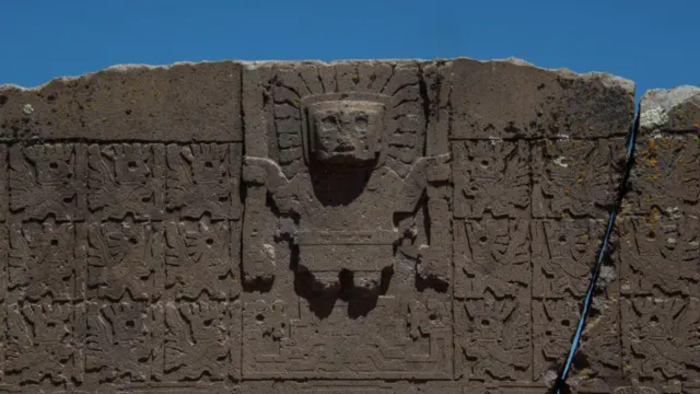
The most striking part begins at the Puerta del Sol, carved from a single 10-ton block of andesite. It's not just a door: it's an astronomical calendar carved in stone. In its center, the figure of the God of Staffs (Viracocha) holds two scepters while 32 winged beings flank him, representing the days, months and agricultural cycles. Archaeologists have discovered that this calendar predicts the solstices with a margin of error of just 0.01 degrees. How did they do it 1,500 years ago without telescopes or computers? Nobody knows.
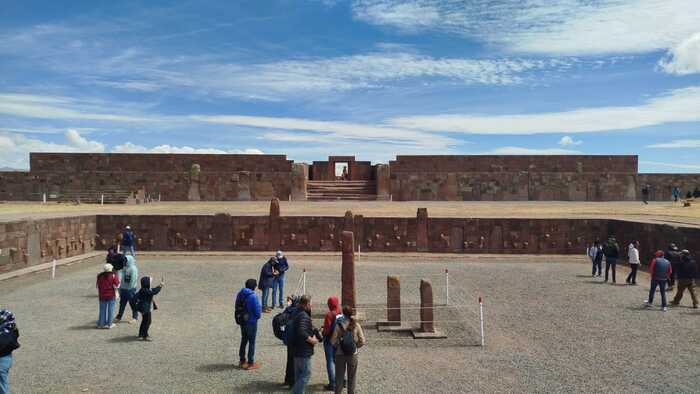
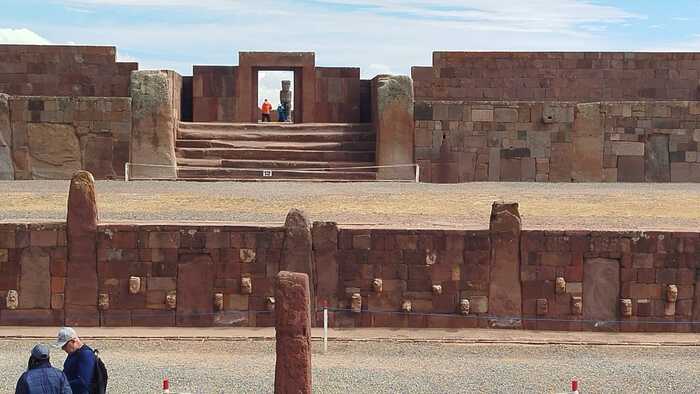
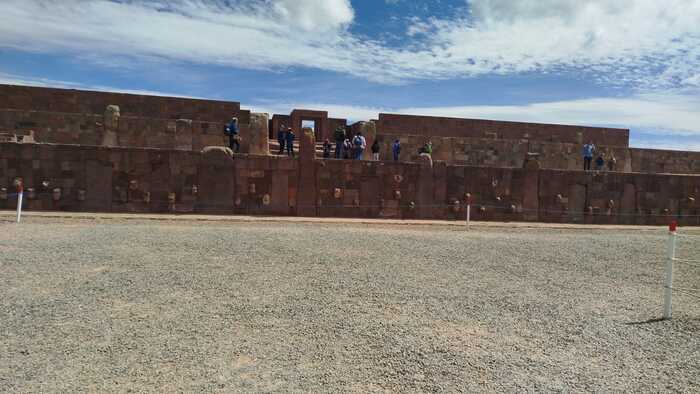
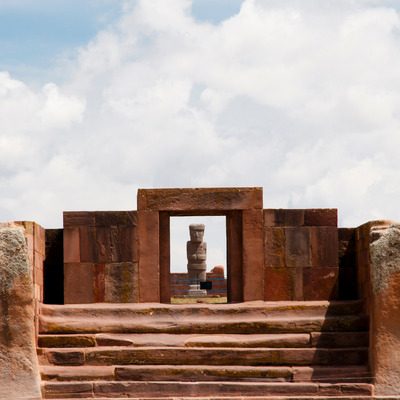
The Semi-subterranean Temple is another of the mysteries. Sunken into the earth, its walls are studded with 175 stone heads – clava heads – that represent human, feline and reptile faces. Some smile. Others have wild eyes. A few seem to scream. Legend says that each head is an enemy decapitated by the Tiwanakota warriors, whose spirits were trapped in the stone to watch over the temple for eternity. Archaeologists have a less poetic but equally disturbing theory: they could be representations of trepanned skulls, since evidence has been found that this culture dominated neurosurgery 1,500 years ago. Bones with perfectly circular holes that healed, proof that the patients survived the operation.
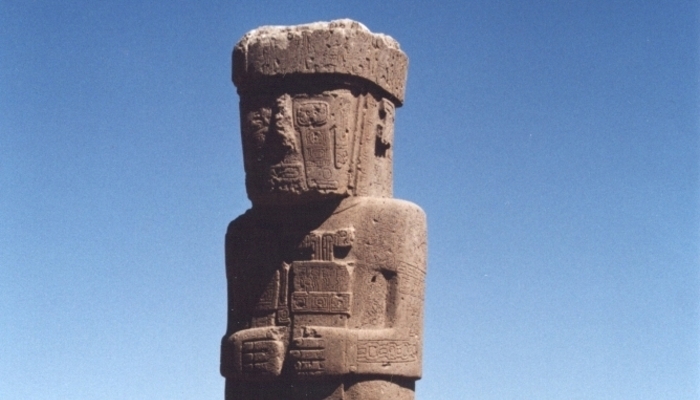
The Bennett Monolith (or Pachamama) is the giant of the place. It measures 7.3 meters tall and weighs 20 tons. It is carved with symbols that, according to the latest studies, are a star map of the Milky Way. His arms are bent towards his chest, holding what look like ceremonial vessels. The Aymara believe that the monolith drinks energy from the sun during the day and the moon during the night, and that whoever touches its base with respect receives a little of that energy. Tourists hug him for the photo. Local elders simply bow their heads as they pass.
The Akapana Pyramid dominates the complex with its original 18 meters of height (today eroded to 15). It is not just any pyramid: it is oriented precisely to the cardinal points and had an artificial lagoon of sacred water at its top. The Spanish dismantled it stone by stone to build churches in La Paz, so today it looks more like a hill than a pyramid. But if you climb to the top (with your heart racing from the effort at 3,850 meters), the view is overwhelming: the entire complex at your feet, Lake Titicaca shining to the north and, on clear days, the snows of Illimani silhouetted against the horizon.
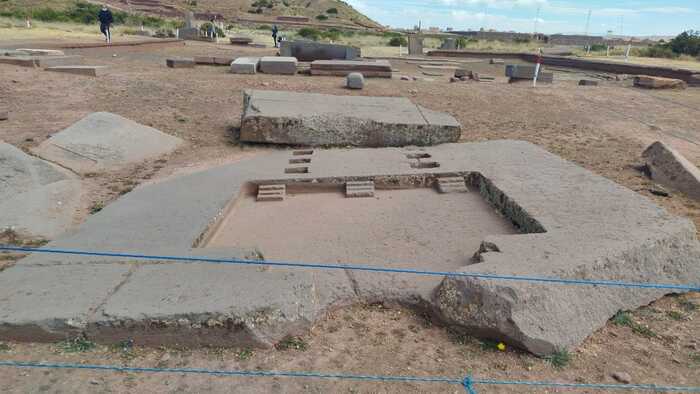
And then there is Puma Punku, the place that puzzles archaeologists. Here the stone blocks are not rectangular: they have complex geometric shapes, with perfectly right-angled grooves, millimeter-precise holes and mirror-polished surfaces. They are made of andesite, a rock so hard that it can only be cut with a diamond. The Incas, who arrived 500 years later, were unable to replicate this technology. Neither do the Spanish. Modern engineers have attempted to cut andesite with diamond saws and have not achieved the same precision. The wildest (and most popular) theory is that these blocks were molded with soft clay that was then hardened, as if the Tiwanakotas knew a secret of alchemy lost forever. The most accepted theory is simply that we don't know how they did it. And that, in a museum, is the most exciting thing that can happen.
The Ceramic and Lithium Museum keeps the most delicate pieces of the site. Here are the famous keros (wooden and ceramic ceremonial vessels) painted with scenes of sacrifices, dances and fertility rituals. The obsidian and copper tools with which they carved the monoliths are also on display. And there is a chilling detail: a collection of trepanned skulls, with their holes perfectly healed. Next to it, a display case displays surgical instruments: obsidian knives, bone needles and llama wool bandages. Tiwanak neurosurgery was more advanced than European neurosurgery of the same time. And you are seeing it with your own eyes.
The winter solstice (June 21) is the most magical time to visit Tiwanaku. Thousands of people, including tourists and Aymaras from neighboring communities, gather at dawn in front of the Puerta del Sol. When the sun emerges behind the hill, its first rays cross exactly the opening of the door and illuminate the main altar of the temple. It's an archaeoastronomy phenomenon that's been going on for 1,500 years, and the alignment is still perfect. The Aymaras sing, offer coca leaves and thank Pachamama. Tourists take photos with their phones. And the sun, indifferent, continues to rise as it has done every June 21 since the first Tiwanakota priest decided to build his calendar in stone.
At dusk, when the last tourists leave and the sun sets behind the Akapana, the complex is left alone. The wind whistles between the monoliths. The shadows of the nail heads lengthen on the ground. The guides close the doors and you leave with your head full of questions. How did they move those stones? How was andesite carved? Who really were these architects of time? Tiwanaku does not give answers. It only offers more questions, shrouded in silence, stone and plateau.